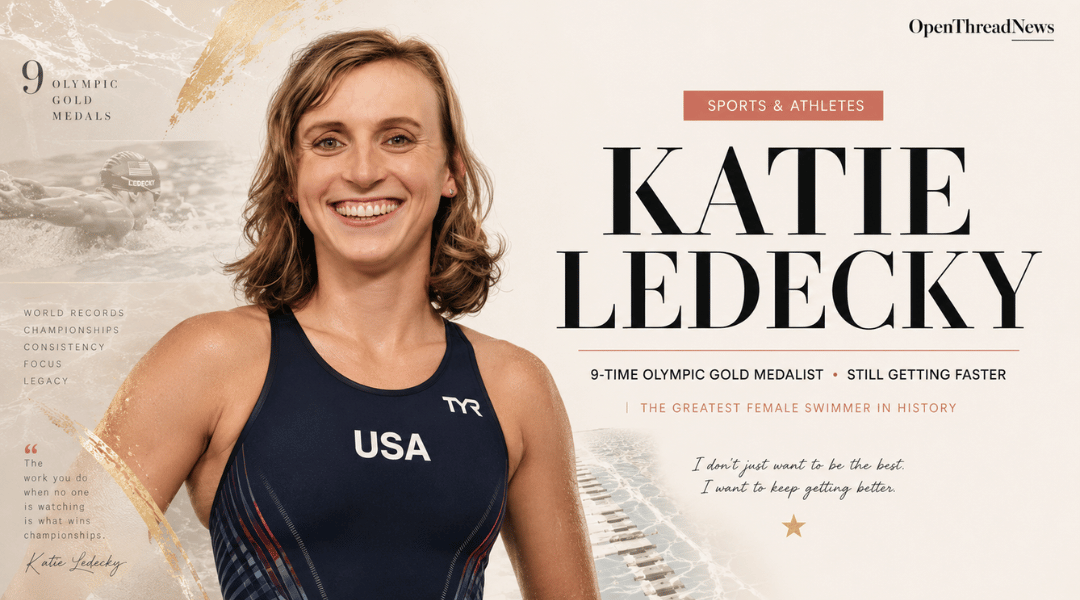
In January 2026, at the TYR Pro Swim Series in Austin, Katie Ledecky swam the 1500m freestyle in 15:23.21. It was the second-fastest performance in the history of the event. The fastest performance in the history of the event is also hers, set in 2018.
She is 29 years old.
Most elite distance swimmers have retired or significantly regressed by this point. The conventional sports science understanding of peak age windows for female endurance athletes places prime competitive years somewhere in the early-to-mid twenties. Ledecky is currently in the process of making that framework obsolete.
Born March 17, 1997, in Washington, D.C., and raised in Bethesda, Maryland, Kathleen Genevieve Ledecky is the most decorated female swimmer in Olympic history and the most decorated American woman in Olympic history. Her career totals: 14 Olympic medals, 9 of them gold, 23 World Championship titles. She holds the long-course world records in both the 800m and 1500m freestyle. She has a Stanford psychology degree, a New York Times bestselling memoir, a POTS diagnosis she has managed for over a decade, and a quiet Catholic faith she has carried since childhood.
She is also, by every available measure, still improving. She posts as @katieledecky on Instagram, X, and TikTok.
Growing Up in Bethesda
Ledecky’s father David is an attorney. Her mother Mary Gen, born Hagan, swam competitively at the University of New Mexico — an influence on her daughter’s development that is easy to trace. Her older brother Michael swam competitively too, and it was watching him at the pool that led a six-year-old Katie to ask if she could join.
She attended Stone Ridge School of the Sacred Heart in Bethesda, a Catholic institution where she developed both her athletic foundation and the quiet faith that still accompanies her on race days. She has spoken about saying a Hail Mary before major races — not as performance ritual but as a way of centering herself before competing. It’s a detail that fits the broader picture of someone who has spent decades building internal architecture that external pressure cannot dismantle.
Her Czech and Jewish heritage comes through her father’s side; her paternal grandfather emigrated from Czechoslovakia in 1947. Her maternal roots are Irish. She is not someone who discusses her background extensively in public — she tends to let the swimming do most of the talking.
London 2012: The 15-Year-Old Who Shocked Everyone
At the 2012 London Olympics, Katie Ledecky was the youngest member of the US Olympic team. She was 15 years old, largely unknown outside of elite swimming circles, and seeded nowhere near the top of the 800m freestyle field.
She won. Convincingly. She defeated reigning champion Kate Ziegler and posted a time that announced, without ambiguity, that something genuinely unusual had entered the sport.
The performance established the pattern that has defined her career ever since: not just winning, but winning by margins that force commentators to search for new language. In distance freestyle, races are typically decided by fractions. Ledecky wins by lengths.
Rio 2016 and the Peak of a Dominance That Had No Ceiling
If London was the introduction, Rio was the declaration.
At the 2016 Rio Olympics, Ledecky won four gold medals — in the 200m, 400m, 800m freestyle, and the 4x200m relay — and a silver in the 4x100m relay. She broke her own world records in both the 400m and 800m freestyle in the process. The margins of victory in her individual events were so large that broadcasters struggled to frame them as competitive races.
Her 800m world record of 8:04.79, set at the 2016 Rio Games, still stands. Her 1500m world record of 15:20.48, set in 2018, still stands. She has been competing at the elite international level for 14 years and is still the person everyone else is chasing.
The POTS Diagnosis She Revealed to the World in 2024
Here is what the “What syndrome does Katie Ledecky have?” search is actually asking about.
In her 2024 memoir, Ledecky disclosed that she was diagnosed with Postural Orthostatic Tachycardia Syndrome (POTS) in 2015, after fainting and experiencing extreme fatigue at the World Championships in Kazan. POTS affects the autonomic nervous system, causing dizziness and a rapid increase in heart rate upon standing. In more severe cases it is genuinely debilitating. In Ledecky’s case — managed through a high-sodium diet, extreme hydration, and her consistent aquatic training routine — it has not prevented her from becoming the most decorated female Olympian in American history.
The disclosure reframed what the public had understood about her career. Between the 2015 diagnosis and the 2024 memoir, she had set multiple world records, won three more Olympic gold medals, and accumulated 23 World Championship titles. All of it while managing a condition that most people associate with limitations.
Sports scientists have since noted that the aquatic environment is actually protective for POTS patients — the horizontal position and water pressure assist venous return in ways that standing exercise cannot — which may partly explain why elite swimming and POTS coexist in her case more effectively than they would in land-based sports.
Tokyo, Paris, and the Record That Had Never Been Done
| Year | Competition | Events | Medals |
|---|---|---|---|
| 2012 | London Olympics | 800m free | 1 Gold |
| 2016 | Rio Olympics | 200m, 400m, 800m free, 4x200m relay, 4x100m relay | 4 Gold, 1 Silver |
| 2020 | Tokyo Olympics | 800m, 1500m free, 400m free, 4x200m relay | 2 Gold, 2 Silver |
| 2024 | Paris Olympics | 800m, 1500m free, 4x200m relay, 400m free | 2 Gold, 1 Silver, 1 Bronze |
At the Paris 2024 Olympics, her 800m freestyle gold made her the first woman to win the same individual swimming event at four consecutive Olympics. She is tied with Soviet gymnast Larisa Latynina for the most gold medals ever won by a female Olympian in any sport, at nine.
She is 29. Latynina competed across three Olympics and retired at 29. Ledecky is discussing her fifth.
The Stanford Years, the NIL Timing, and Turning Pro
She enrolled at Stanford in 2016 and graduated in 2020 with a degree in Psychology and a minor in Political Science. She competed collegiately for two seasons before turning professional in 2018 — a decision made necessary by the sponsorship economics of the era. Because NCAA NIL rules did not exist until 2021, she had to formally sacrifice her final two years of collegiate athletic eligibility to legally accept endorsement money.
It is one of the cleaner illustrations of how the old NCAA structure penalized athletes with real market value. Had she competed in the current NIL environment, she could have remained at Stanford through graduation while earning commercially. Instead, she had to choose.
She chose the money, finished her degree anyway, and has carried both the Stanford credential and the professional career simultaneously ever since. In May 2026, Yale awarded her an honorary degree at its 325th commencement.
She now trains in Gainesville, Florida, under University of Florida head coach Anthony Nesty, alongside elite pros including Bobby Finke. The decision to relocate from Stanford’s pool to a professional training environment reflects a deliberate choice to extend her career through structure that collegiate programs aren’t designed to provide.
“Just Add Water” and What the Memoir Actually Contains
Published by Simon & Schuster in June 2024, Just Add Water: My Swimming Life became an instant New York Times Bestseller, peaking in the top five of the non-fiction list during the Paris Olympic media cycle.
The book is not a standard athlete autobiography. It covers her childhood, her training regimens in granular detail, the 2015 POTS diagnosis, and — most compellingly — the mental architecture that has allowed her to sustain dominance across four Olympic cycles. The anxiety, the perfectionism, the specific psychological work of competing against your own world records rather than other athletes.
That last element is genuinely unusual in sports writing. Most elite athletes compete against fields. Ledecky, for most of the last decade, has competed against times that she herself set. The psychological framework required to maintain that as motivation rather than pressure is the actual subject of the book, and it reads differently from standard sports memoir as a result.
The “Gender” Question — And Why It Keeps Appearing
The PAA question “What gender is Katie Ledecky?” deserves a direct answer: she is a cisgender woman.
The search exists because a bad-faith segment of the internet routinely targets dominant female athletes — particularly those who are tall, physically imposing, or win by unusual margins — with baseless speculation about their biological sex. Ledecky is 6’0″ with exceptional wingspan and wins distance freestyle races by margins that have no recent precedent. For a specific corner of online culture, that is apparently suspicious.
It is not. She is a woman who has been competing in women’s swimming since she was 15, has passed every drug test administered over a 14-year career, and whose physical characteristics are well within the documented range of elite female distance swimmers.
The Chinese Doping Scandal and Her Public Position
Ledecky is famously scandal-free in terms of her own conduct. The one public controversy adjacent to her involves the World Anti-Doping Agency.
Prior to the Paris 2024 Games, Ledecky was among the athletes who spoke critically about WADA’s handling of the Chinese swimming doping scandal, in which multiple Chinese swimmers had tested positive for a banned heart medication but were cleared by Chinese anti-doping authorities. The episode raised serious questions about whether major swimming nations with different testing standards were competing on equal terms.
Her willingness to speak publicly about systemic failures in anti-doping oversight — while carefully avoiding personal accusations — positioned her as one of the more credible voices on the issue among active competitors. The conflict of interest for athletes who might antagonize national federations or governing bodies by speaking out is real. She spoke out anyway.
Sponsors, Earnings, and What a $7 Million TYR Deal Looks Like
When Ledecky turned professional in 2018, she signed a $7 million deal with TYR Sport as her primary athletic sponsor. The deal remains foundational to her commercial portfolio, which also includes Adidas, Visa, and Panasonic. Combined with Olympic performance bonuses — which compound substantially across four Games — her estimated net worth sits between $10 million and $15 million as of 2026, making her one of the highest-paid swimmers in the history of the sport.
The viral chocolate milk video from 2020, in which she swam an entire pool length with a full glass balanced on her head without spilling a drop, was part of a “Got Milk?” campaign partnership. It accumulated millions of views and demonstrated something important about her brand beyond athletics: she has warmth and humor that pure athletic dominance does not always translate into.
Her philanthropic commitments include STEM education for girls, the Wounded Warrior Project, and Shepherd’s Table. She leads swim clinics for Special Olympics athletes. These are not checkbox philanthropy items — they appear consistently across her public presence in ways that suggest genuine priority rather than brand management.
Michael Phelps, Summer McIntosh, and What the Swimming World Says
Michael Phelps has been among the most vocal in assessing her legacy. He has called her the greatest female swimmer of all time and recently stated: “She is doing things that women have never done before because she isn’t afraid to think outside the box… Her mind is open to everything.”
The r/swimming and r/olympics communities treat her as an untouchable icon. The primary current debate is not whether she belongs in the conversation with the all-time greats — that conversation is settled — but whether she can sustain her dominance against rising teenage stars like Summer McIntosh, the Canadian phenom who has pushed her harder than anyone in recent years.
The 15:23.21 in Austin in January 2026 suggests Ledecky’s answer to that question is: yes, for now, and possibly for longer than anyone expected.
August brought the plot twist. At the 2026 Pan Pacific Championships in Irvine, California, Australia’s Lani Pallister beat Ledecky in the 800m freestyle, 8:06.10 to 8:07.26, ending Ledecky’s run of 13 international championship golds in the event, a streak stretching back to London 2012. It was the first time she had ever lost the 800m at an international meet. Pallister also beat her in the 400m free earlier in the week. Ledecky answered by winning the 1500m in 15:36.09, her first international medal won on American soil, and called the 800m silver her best swim of the meet. Two years out from a home Olympics in Los Angeles, the 800m finally has a genuine rivalry.
Katie Ledecky at 29: What Comes Next
She has said she is taking her career year by year. She is also unmistakably pointing toward the 2028 Los Angeles Olympics, which would be her fifth Games. She would be 31.
For context: among the greatest female swimmers in history, 31 is not a competitive age. It simply isn’t, by the established literature on athletic aging in aquatic sports. Ledecky is in the process of rewriting that literature in real time, which is not a phrase that gets used often and means something specific here. The 2026 Pro Swim Series performances are not the results of a 29-year-old running on reputation. They are the results of an athlete who is still, demonstrably, improving.
Like Olivia Reeves, whose weightlifting career is built around consistent technical refinement, and Sydney McLaughlin-Levrone, who manages her own physiological complexity with elite precision, Ledecky represents a category of athlete whose longevity is not accidental. It is the product of meticulous, deliberate management of a body that has been performing at the highest level for nearly 15 years.
LA 2028 is two years away. Her world records are still standing. She is still the second-fastest person to ever swim 1500 meters. The first is also her. Like fellow American star Suni Lee, who is also targeting the Los Angeles 2028 Games, Ledecky is aiming to shine at a home Olympics.
Frequently Asked Questions
Did Katie Ledecky retire?
No. Katie Ledecky is actively competing in 2026. She swam the second-fastest 1500m freestyle in history at the TYR Pro Swim Series in Austin in January 2026 and is headlining the June 2026 Indianapolis Pro Swim Series. She has expressed strong intent to compete at the 2028 Los Angeles Olympics, which would be her fifth Olympic Games. At the August 2026 Pan Pacific Championships in Irvine, she won gold in the 1500m and took silver in the 800m and 400m freestyle.
What syndrome does Katie Ledecky have?
Katie Ledecky was diagnosed with Postural Orthostatic Tachycardia Syndrome (POTS) in 2015 after fainting and experiencing extreme fatigue at the World Championships in Kazan. POTS affects the autonomic nervous system and can cause dizziness, fatigue, and a rapid heart rate when standing. She disclosed the diagnosis in her 2024 memoir, Just Add Water, and manages the condition through a high-sodium diet, consistent hydration, and regular training.
What does Katie Ledecky eat?
Ledecky follows a high-sodium diet as part of her POTS management plan, which requires increased salt intake to help maintain blood pressure and fluid balance. She has also discussed the substantial nutritional demands of elite distance-swimming training, which requires a high caloric intake to support long hours in the pool. Her memoir, Just Add Water, provides additional insight into her nutrition and training routines.
Why is Katie Ledecky so much faster than everyone else?
Sports scientists attribute Ledecky’s success to a combination of factors, including exceptional aerobic capacity, an efficient freestyle stroke that conserves energy at high speeds, elite lactate-threshold endurance, and a training volume sustained over nearly 15 years at the highest level. Her experience managing POTS has also required a high degree of physiological awareness, which may contribute to her pacing and race strategy.
Is Katie Ledecky in a relationship?
Katie Ledecky keeps her personal life private and is not publicly known to be in a relationship. She has not discussed a partner in interviews or on social media.
What is Katie Ledecky’s net worth?
Katie Ledecky’s net worth is estimated to be between $10 million and $15 million as of 2026. Her primary sponsor is TYR Sport, with whom she signed a reported $7 million endorsement deal in 2018. Additional partnerships with Adidas, Visa, and Panasonic, along with Olympic performance bonuses earned across four Games, have helped make her one of the highest-paid swimmers in history.