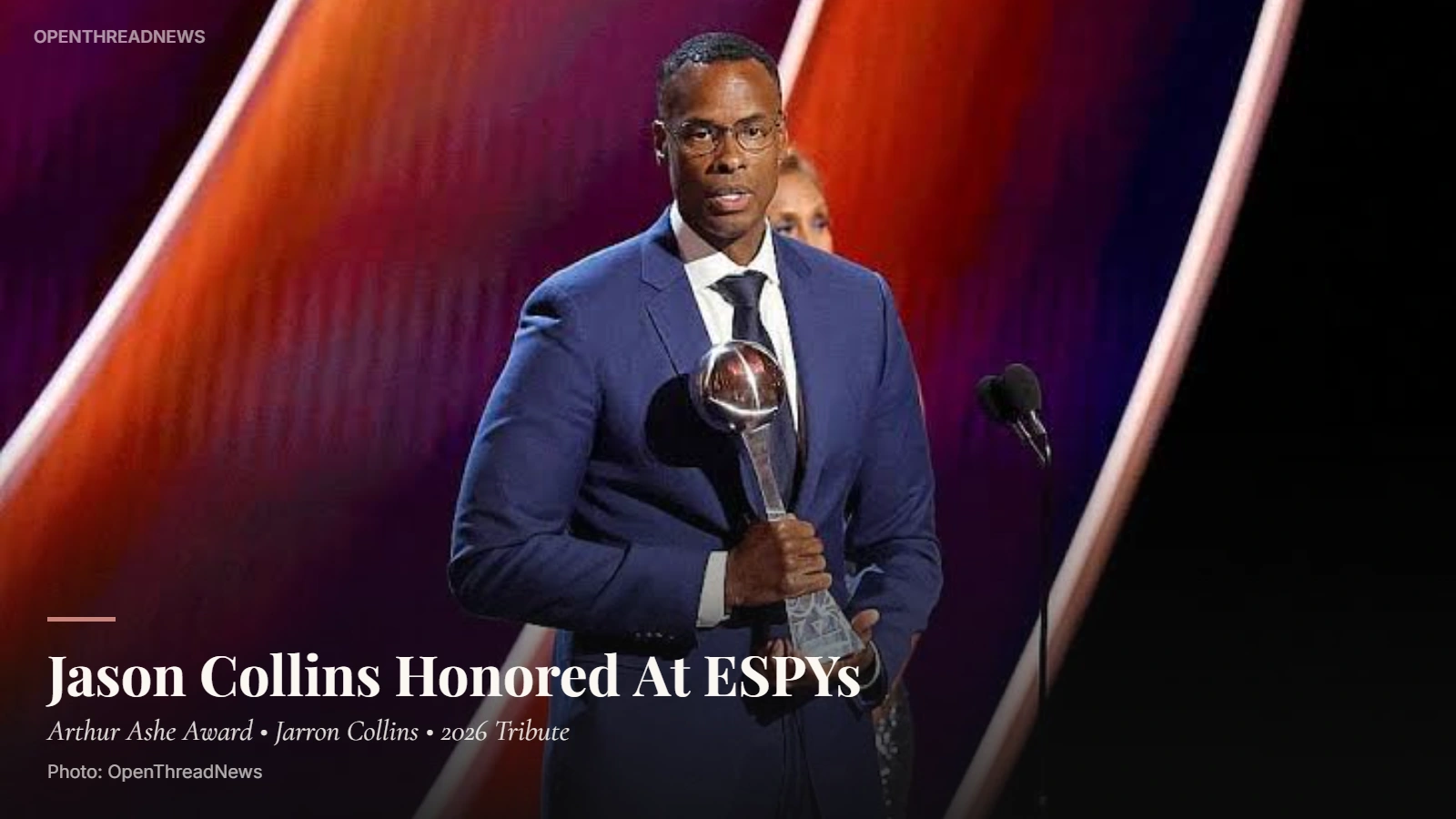
Two months after Jason Collins died from brain cancer at 47, his twin brother walked onto the stage at the 2026 ESPYs to accept an award his sibling never got to see in person. On July 15, 2026, at the David H. Koch Theater at Lincoln Center in New York City, Jarron Collins accepted the Arthur Ashe Award for Courage on behalf of Jason, the NBA center who became the first openly gay player in major U.S. men’s team sports back in 2013.
“I miss my brother,” Jarron said as he opened his remarks. “I wish he was here standing to accept this award. But I find myself honored to be here to accept this award on his behalf.”
A Twin Brother Steps Onto the Stage
Jarron and Jason were twins in the fullest sense of the word: same Los Angeles birthplace, same Harvard-Westlake high school team, same Stanford roster, and the same 2001 NBA draft class. Jarron went on to play 10 NBA seasons with the Utah Jazz before moving into coaching, and he’s currently an assistant coach for the New Orleans Pelicans. None of that history made the ESPYs stage any easier to stand on.
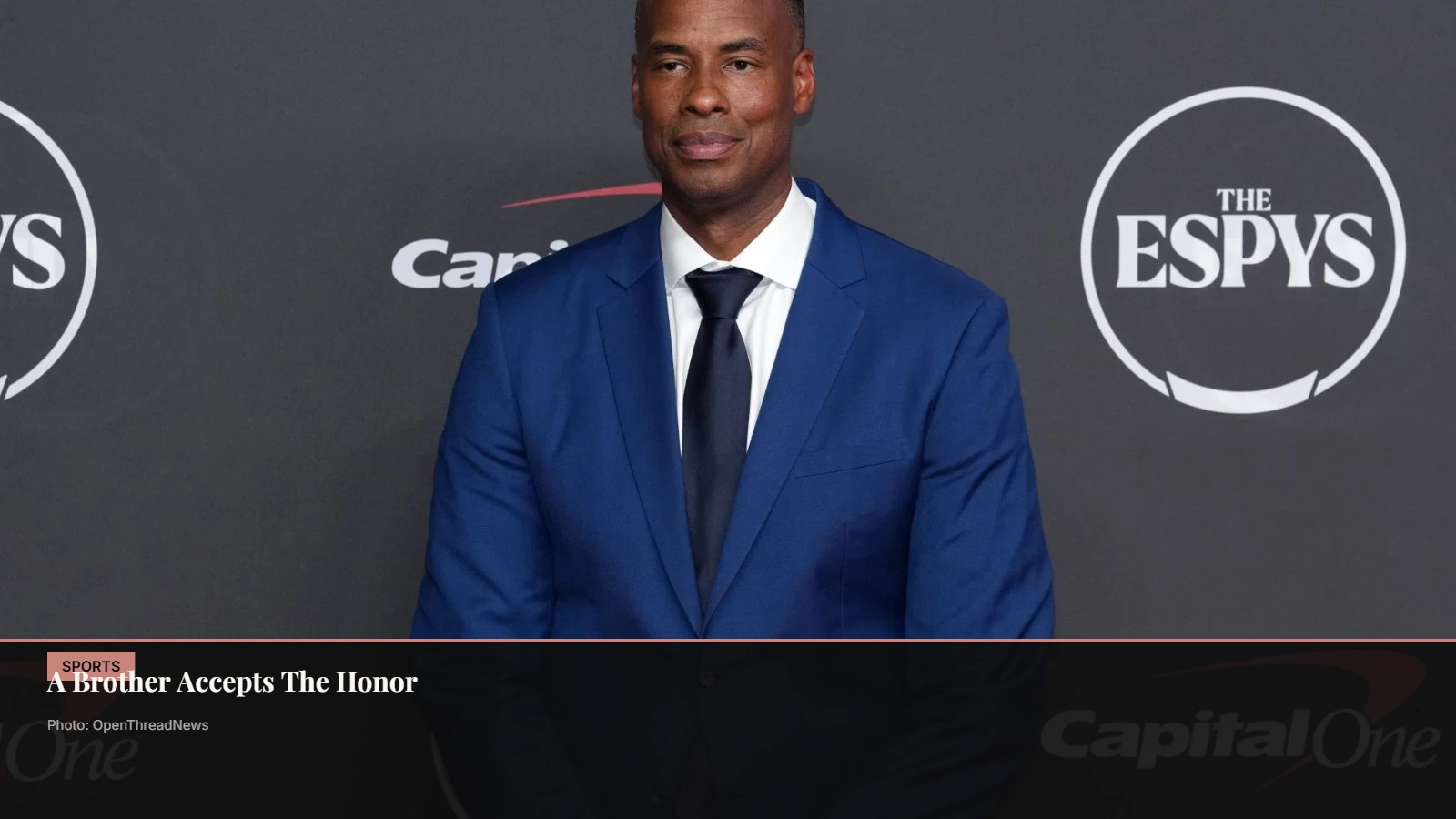
The Arthur Ashe Award for Courage is handed out once a year to someone whose impact reaches past their sport. Past recipients have included athletes who overcame illness, discrimination, or personal tragedy to change how their sport, or the public, saw them. Jason Collins’ 2013 decision to come out publicly, at the time an unprecedented move in the four major North American men’s leagues, fit that criteria as directly as any honoree in the award’s history. ESPN confirmed Collins would receive the award posthumously back in June, roughly a month after his death.
“The Bravest and Strongest Man I’ve Ever Known”
Jarron used much of his speech to talk about a detail most fans never knew: Jason’s fascination with tennis, and with Arthur Ashe specifically. “He was actually obsessed,” Jarron told the crowd. “He traveled to many tournaments and watched many matches at Arthur Ashe Stadium. He admired Arthur Ashe not only for being an incredible tennis player, but also for being a pioneer in this world.”
He then turned to the final months of his brother’s life. “These past few months, I told my brother repeatedly, he was the bravest and strongest man I’ve ever known,” Jarron said. “He lived his life with authenticity, with grace, and strength and joy. The courage he showed and the way he moved in this world truly made him a trailblazer, an inspiration to so many others, and his impact will be remembered.”
He closed with a promise to keep his brother’s story alive: “I pledge to make sure that tonight is not the end of my brother’s legacy. It’s just the beginning.” Then, quieter: “I’ve never been more proud of Jason than in this moment right now. What a true accomplishment.”
Why the NBA Chose Jason Collins for This Honor
Collins wrote in a May 2013 Sports Illustrated cover story that he was “a 34-year-old NBA center,” that he was “Black,” and that he was “gay,” a line that instantly made him the first active male athlete in the NBA, NFL, MLB, or NHL to come out. President Obama called him personally to say he was “impressed by his courage.” He didn’t play again until February 2014, when the Brooklyn Nets signed him to a 10-day contract and he checked into a game against the Lakers, becoming the first publicly gay athlete to appear in a major North American men’s league game. He wore No. 98 that season in tribute to Matthew Shepard, the gay student murdered in a 1998 hate crime, and personally delivered an autographed jersey to Shepard’s family that February. Collins retired in November 2014 after 13 NBA seasons across seven franchises. A fuller account of that career, along with his life after basketball, runs in OpenThreadNews’ profile on Jason Collins.
The Months Between the Diagnosis and the ESPYs
Collins’ health changed quickly in the months before his death. He married film producer Brunson Green in May 2025, and by that August, doctors had found a mass in his brain after he wasn’t well enough to make a planned trip to the US Open. The NBA confirmed he was being treated for a brain tumor in a September 2025 statement, and Collins revealed the specific diagnosis himself in a December 2025 ESPN essay: Stage 4 glioblastoma. He sought targeted treatment at a clinic in Singapore before dying on May 12, 2026, at 47. He’s survived by Green and by Jarron.
Frequently Asked Questions
Who accepted Jason Collins’ ESPYs award?
His twin brother, Jarron Collins, accepted the Arthur Ashe Award for Courage on Jason’s behalf at the 2026 ESPYs, held July 15 at Lincoln Center’s David H. Koch Theater in New York City. Jarron is a former 10-season NBA player and now an assistant coach for the New Orleans Pelicans.
Why did Jason Collins win the Arthur Ashe Award?
The ESPYs recognized Collins for coming out in 2013 as the first active gay player in a major North American men’s team sport, and for the years of visibility work that followed, including his 2014 return to the NBA and his choice to wear No. 98 in honor of Matthew Shepard.
When did Jason Collins die, and what was the cause?
Collins died on May 12, 2026, at age 47, roughly two months before the ESPYs ceremony. He had Stage 4 glioblastoma, a brain cancer he revealed publicly in a December 2025 ESPN essay after doctors found a mass in his brain the previous August.