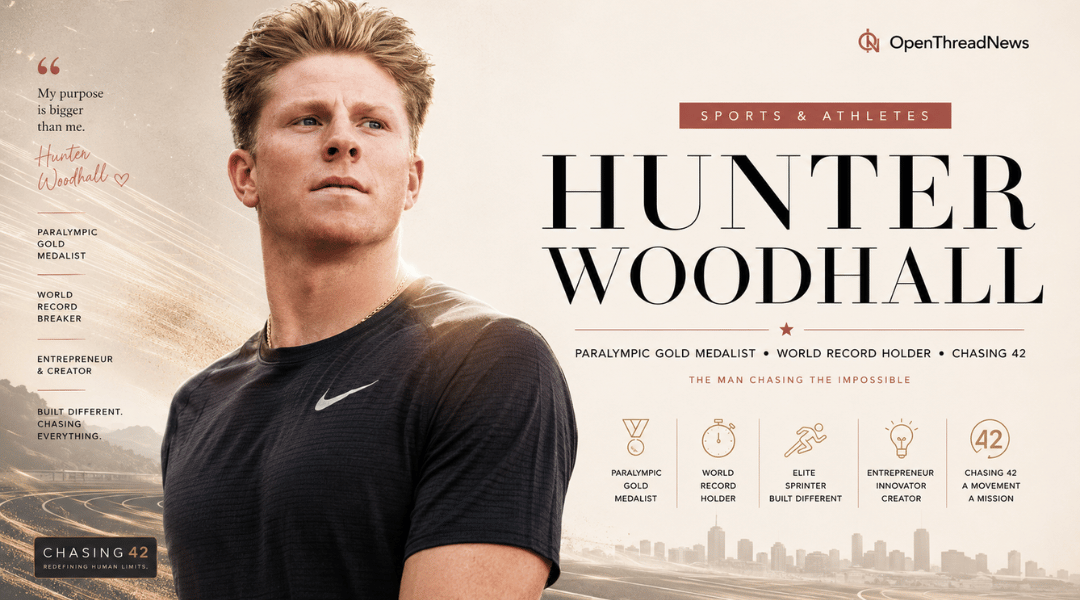
When Hunter Woodhall was 11 months old, his parents made one of the hardest decisions parents are ever asked to make. Born with fibular hemimelia, a congenital condition where the fibula bones in both lower legs never formed, his legs could not develop. Doctors recommended amputation below both knees. His parents agreed.
Twenty-six years later, he stood on the track at the Stade de France in Paris and won a Paralympic gold medal.
Born February 17, 1999, in Cartersville, Georgia, Woodhall grew up in Syracuse, Utah, and became, by any reasonable measure, one of the most compelling athletes the United States has produced in a generation. He is a Paralympic gold medalist, a world record holder, the first double amputee to earn an NCAA Division I track and field scholarship, a TikTok creator with 3.3 million followers and 148 million likes, a co-founder of a clothing brand, a keynote speaker at Cannes Lions, and the husband of Olympic long jump champion Tara Davis-Woodhall.
He is also 27 years old. This is not a career retrospective. He’s just getting started.
Growing Up in Syracuse, Utah
Hunter’s father Steve Woodhall was an Explosive Ordnance Disposal technician in the U.S. Air Force, which is why Hunter was born in Cartersville, Georgia, near a military base. The family settled in Syracuse, Utah, where Hunter grew up alongside brothers Spencer and Brendan.
His early medical care was largely provided by Shriners Hospitals for Children, an institution he credits publicly and often. The guidance he received there, he has said, shaped how he understood his own body. Shriners told him to focus on what he wanted to do rather than what he couldn’t. He was fitted with prosthetics shortly after surgery and switched to carbon-fiber running blades in middle school.
He later became a National Patient Ambassador for Shriners — a full-circle moment for someone whose entire athletic identity was built on proving the hospital’s philosophy correct.
At Syracuse High School, he competed in track against able-bodied runners and won five state championships. That detail alone is worth sitting with. Not five Para athletics state titles. Five state titles, on blades, against runners with biological legs. College programs took notice.
The NCAA Scholarship That Had Never Been Done Before
When Woodhall committed to the University of Arkansas, he made history. He became the first double amputee track and field athlete to earn an NCAA Division I athletic scholarship. Not the first Para athlete to walk onto a Division I program. The first to be recruited on scholarship, full stop.
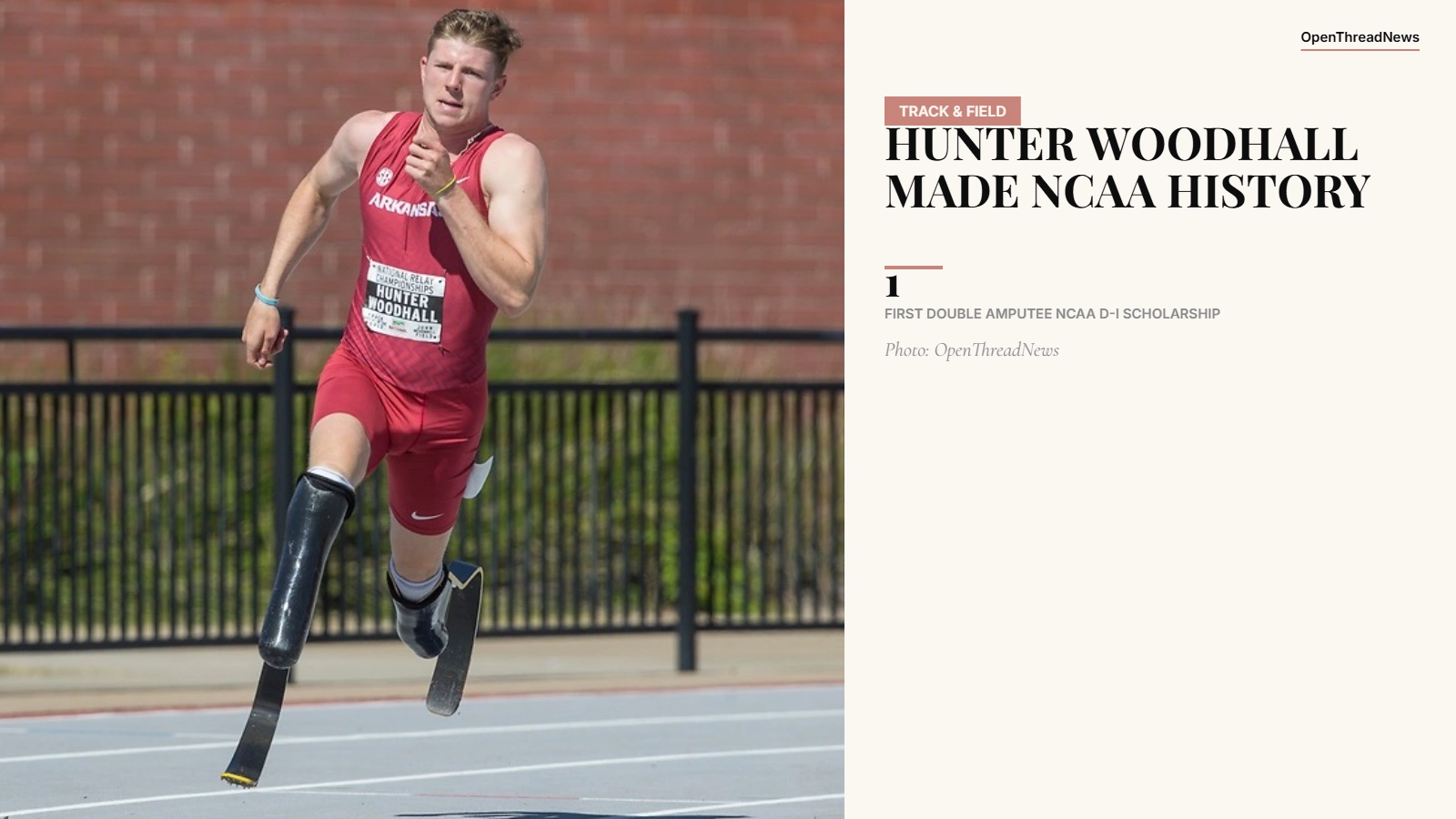
The distinction matters because it reflects how coaches actually evaluated him: not as an inspirational inclusion story, but as a competitive athlete who could contribute to a program. The University of Arkansas Razorbacks track program does not hand out scholarships for optics. They handed one to Hunter Woodhall because he could run.
He has described his disability in terms that have become something of a personal brand mission: “It took time for me to realize that being different is what makes us unique. Something I used to get bullied for became one of the biggest strengths I have.” His Instagram regularly features the caption: “It’s not a disability, it’s an opportunity.”
That framing isn’t motivational poster fluff coming from him. It’s the operating philosophy of someone who has run competitively against able-bodied athletes and won.
Competition Record: From Doha at 16 to Gold in Paris
Woodhall’s international career started early and accelerated fast.
| Year | Competition | Event | Result |
|---|---|---|---|
| 2015 | World Para Athletics Championships (Doha) | 400m T44 / 200m T44 | Silver / Bronze |
| 2016 | Rio Paralympics | 200m T44 / 400m T44 | Silver / Bronze |
| 2020 | Tokyo Paralympics | 400m T62 | Bronze |
| 2024 | Paris Paralympics | 400m T62 | Gold (46.36s) |
| 2024 | Paris Paralympics | 4x100m Universal Relay | Bronze |
| 2024 | World Record | 400m T62 | 45.70s |
A note on the classification change: In his early career he competed in T44, a broad category for lower-limb impairments. In 2018, the International Paralympic Committee created T62 specifically for bilateral below-knee amputees running on prosthetic blades. The reclassification wasn’t a demotion or promotion — it was the IPC recognizing that his specific profile of athlete needed its own category to race fairly.
At the 2015 World Championships, he was 16 years old, coached by legendary Brazilian coach Joaquim Cruz, and already medaling on the international stage. Most athletes don’t reach that level until their mid-twenties.
The 46-Second Barrier, the World Record, and “Chasing 42”
For years, Woodhall talked publicly about wanting to break 46 seconds in the 400m. It became a storyline his followers tracked across competitions. When he set the T62 world record of 45.70 seconds in 2024, the Facebook video he posted with the caption “Been chasing 45 seconds for so long” generated the kind of response that athletes dream about.
But 45 seconds wasn’t the end goal. It was a checkpoint.
His current mission, documented extensively across TikTok and Instagram, is “Chasing 42” — running a 42-second 400m on prosthetic blades. He has called it “impossible.” That’s precisely the point. The Chasing 42 content series has become a flagship creative project, attracting brand partnerships including Deloitte, which has sponsored the content explicitly around the theme of pursuing what others say can’t be done.
A 42-second 400m on blades would be, by an enormous margin, the fastest time ever recorded in Para athletics at that distance. Whether it’s achievable is genuinely unknown. That uncertainty is what makes it compelling content and, for Woodhall, compelling motivation.
The Paris 2024 Withdrawal That Broke His Heart First
Before the gold medal in Paris, there was a different Paris story.
In July 2023, Woodhall withdrew from the Para Athletics World Championships, also held in Paris, at the last minute. The reason: his prosthetic sockets were severely ill-fitted, causing sores and blisters that made sprinting physically impossible. In most sports, an equipment malfunction is a mechanical inconvenience. In Para athletics, equipment is the interface between an athlete’s body and the ground. If the fit is wrong, the athlete cannot compete.
He posted about it publicly, describing the frustration of having prepared for a major championship and being unable to start. The withdrawal generated the “What happened with Hunter Woodhall?” search spike that still surfaces in Google’s People Also Ask results.
One year later, in Paris, at the same city, at the same venue type, he won gold. The symmetry wasn’t lost on anyone watching.
The Meet-Cute That the Internet Won’t Stop Asking About
The second-most searched question about Hunter Woodhall, behind how he lost his legs, is how he met Tara.
The answer is almost annoyingly cinematic.
It was 2017, at the Simplot Games, an indoor track meet in Pocatello, Idaho. Both were high school seniors — Hunter in from Utah, Tara in from California. Hunter was warming up, spotted Tara across the venue, and immediately texted his best friend: “This is the girl I am going to marry.”
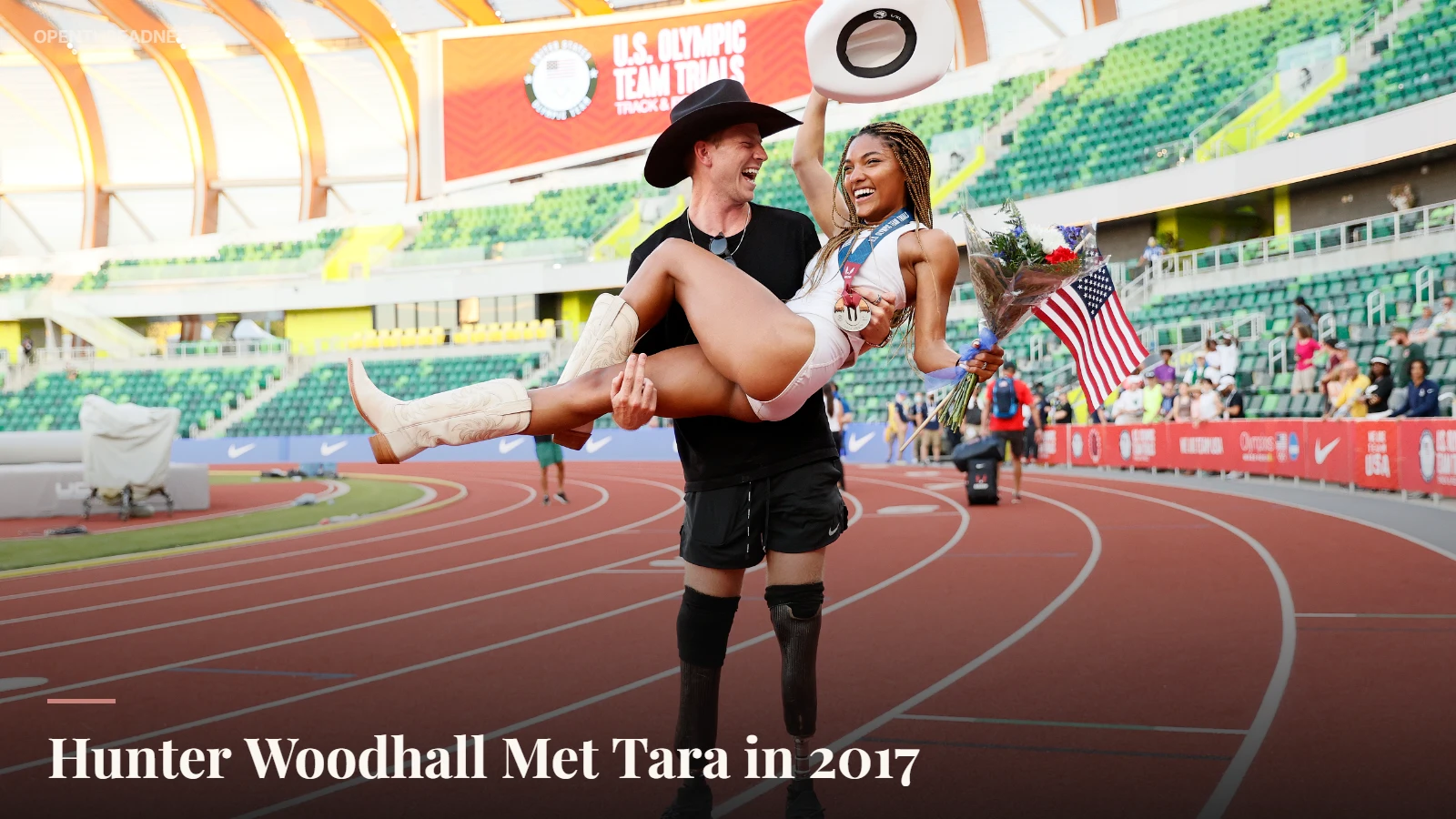
He won his 400m race. Tara, who had apparently also noticed him, walked over while he was catching his breath and said, completely unprompted: “I don’t know why, but I just feel like I need to give you a hug.”
They followed each other on Instagram. Tara slid into his DMs with “Past your bedtime!” They navigated a long-distance relationship through college — him at Arkansas, her competing on the USATF circuit — before getting married on October 16, 2022.
Their joint YouTube channel, @thewoodhalls, documents their life as a pro track couple with enough authenticity that it has built hundreds of thousands of subscribers. The shared content doesn’t feel produced. It feels like two people who genuinely like each other and happen to both be elite athletes.
How Hunter Woodhall Built a Creator Career
The numbers are not small. 3.3 million TikTok followers. 148 million likes. 872,700 Instagram followers. A joint YouTube channel with Tara that pulls hundreds of thousands of subscribers.
His TikTok content formula works because it refuses to be earnest in the way disability content is expected to be earnest. Self-deprecating humor about his lack of legs sits alongside intense training montages and tutorials showing how his blades actually attach — the mechanical reality of what it takes to sprint at world-record pace on carbon fiber prosthetics. Viewers who come for the inspiration stay for the personality.
He went viral on a completely different kind of platform when he appeared on The Ellen DeGeneres Show, where Ellen gifted him $20,000 toward his training. He followed that with an appearance on Harry and has since moved into corporate speaking, delivering keynotes at RootsTech 2025 and the Cannes Lions festival, one of the most prestigious stages in global advertising and marketing.
His LinkedIn describes him as “Paralympic Gold Medalist, entrepreneur, speaker, and the first double amputee to earn an NCAA Division I track scholarship.” The entrepreneur piece isn’t a vanity title. He co-founded Giant Hoodies, a clothing brand built around his creator platform and driven by e-commerce sales to his existing audience.
His sponsor roster reflects all of this: Nike for the athletic credibility, Össur as his prosthetics manufacturer, Deloitte for the Chasing 42 narrative, and Cadence as an additional brand partner. That’s a portfolio that looks more like a lifestyle athlete at the intersection of sports and culture than a traditional Para athletics competitor.
Net Worth and Earnings
Estimates place Woodhall’s net worth between $1 million and $3 million, with the caveat that Para athletics prize money is not the primary driver. Track meet winnings in the Paralympic circuit are modest by professional sports standards. His wealth comes from the creator economy, Giant Hoodies equity, brand deal income across Nike, Össur, Deloitte, and Cadence, and speaking fees.
Elite Paralympic gold medalists with significant social media followings typically command $20,000 to $50,000 per keynote appearance. His bookings at Cannes Lions and RootsTech confirm he operates at that level rather than the entry-tier speaking circuit.
The comparison point is useful: athletes like Ilona Maher have demonstrated how Olympic-profile athletes with authentic creator presences can build substantial commercial careers alongside sport. Woodhall has the same structural advantages — elite credentials, genuine personality, and a loyal following — and has been building that infrastructure longer.
What’s Next
As of June 2026, Woodhall is in active competition season. His recent Instagram post following a frustrating meet was notably candid: “Really frustrated at how this went down. Was so excited to execute my race today, and felt like it was over before it began. But as frustrated as it made me, I learned. I learned I gotta be prepared for anything that could pop up. Overall I’m glad I didn’t stop, something’s building.”
That transparency is the thing that separates his creator presence from a managed athlete account. He posts the bad days.
The 2028 Los Angeles Paralympics are the obvious next major target — a home Games, in a city where both he and Tara already compete and train, at the absolute peak of their athletic careers. For a 27-year-old who won his first Paralympic gold at 25 and set a world record in the same year, the ceiling is genuinely unclear.
Frequently Asked Questions
How did Hunter Woodhall become disabled?
Hunter Woodhall was born with fibular hemimelia, a congenital condition where the fibula bones in both lower legs never formed. His parents chose to have both legs amputated below the knee when he was 11 months old, as the legs could not develop properly without the fibula. He was fitted with prosthetics shortly after and switched to carbon-fiber running blades in middle school.
How did Tara Davis and Hunter Woodhall meet?
They met in 2017 at the Simplot Games, an indoor track meet in Pocatello, Idaho, during their senior year of high school. Hunter saw Tara warming up and texted his best friend that he was going to marry her. After his race, Tara walked over and told him she felt compelled to give him a hug. They followed each other on Instagram, Tara messaged him first, and they maintained a long-distance relationship through college before marrying on October 16, 2022.
What happened with Hunter Woodhall?
Most searches for this question relate to either how he was born without lower legs (fibular hemimelia) or his July 2023 withdrawal from the Para Athletics World Championships in Paris, where ill-fitting prosthetic sockets caused severe blisters that made competing impossible. He returned the following year and won Paralympic gold in Paris at the 2024 Games.
Are Tara and Hunter Woodhall still together?
Yes. As of June 2026, Tara Davis-Woodhall and Hunter Woodhall are married and active together on their joint YouTube channel and Instagram account, @thewoodhalls. They both won gold medals at the 2024 Paris Games, Tara at the Olympics in long jump and Hunter at the Paralympics in the 400m T62.
What is Hunter Woodhall’s world record?
Hunter Woodhall holds the T62 400m world record of 45.70 seconds, set in 2024. The T62 classification is for bilateral below-knee amputees competing on prosthetic running blades. His current goal, documented in his “Chasing 42” content series, is to run a 42-second 400m, a time that would shatter existing Para athletics records.
What is Hunter Woodhall’s net worth?
Estimates place his net worth between $1 million and $3 million. His income comes primarily from brand deals with Nike, Össur, Deloitte, and Cadence, his co-founded clothing brand Giant Hoodies, creator revenue from TikTok and YouTube, and keynote speaking fees at events including Cannes Lions. Para athletics prize money is a smaller portion of his overall income.