

She called it “Project Six.”
In late April 2026, Allyson Felix sat down with her brother and manager, Wes Felix, with a pitch deck on her laptop and explained what she wanted to do next. He had braced himself for something manageable: maybe a few 10Ks, a half-marathon, something befitting a 40-year-old retired Olympian who had already done more than anyone. What she actually wanted was a sixth Olympic appearance, at the 2028 Games in Los Angeles, in her hometown, at age 42.
“I felt there was a zero percent chance that’s what she was going to say,” Wes told Time. “I could have thought of a million things before she said that.”
On April 27, 2026, Felix announced the plan publicly on Instagram. “In a million years… I never thought I’d return,” she wrote. “And somehow, here I am — reaching for LA 2028, on my own terms. I’m not here trying to relive who I was. The world tells women that after 40, we should slow down — be smaller, quieter. Satisfied. But this is my love story with LA.”
This is the story of how she got here.
Growing Up in Los Angeles, Running Before Anyone Was Watching
Felix was born on November 18, 1985, in Los Angeles, California, and grew up in a family with deep roots in the city. Her mother, Marlean Felix, is a Cal State LA alumna and retired elementary school teacher. Her brother Wes, her career-long manager, attended USC alongside Allyson.
She discovered her talent for sprinting early and enrolled at University of Southern California, where she competed collegiately before turning professional. She was 19 years old when she ran her first Olympic final.
That was 2004.
Five Games, Twenty Years, Eleven Medals
The arc of Felix’s competitive career spans five decades and five Olympic Games, a timeline that begins at Athens 2004 and closes (for now) at Tokyo 2020, which was actually held in 2021.
In Athens, she won silver in the 200m at 18 years old, immediately establishing herself as the heir apparent to the event. She won silver again in the 200m at Beijing 2008, this time behind Veronica Campbell-Brown. The gold eluded her in both Games, leading to a national conversation about whether she would ever close the deal in her signature event.
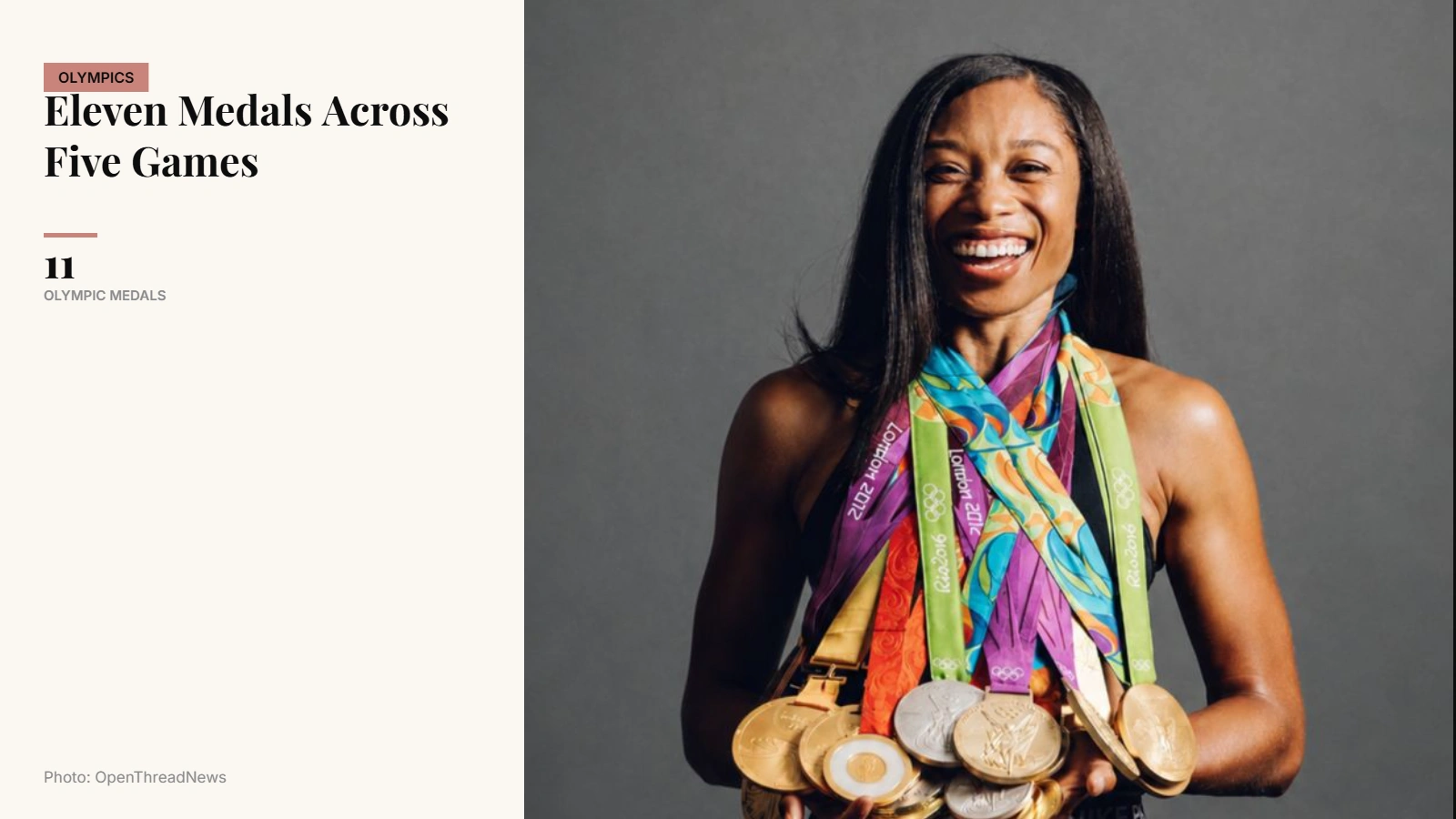
London 2012 was the answer. Felix won 200m gold at 26 in a performance that settled the question definitively. She became the first American woman to win three gold medals in a single track and field Olympics that year, adding relay golds in the 4x100m and 4x400m. That 200m title was not matched by another American woman for twelve years, until Gabby Thomas won gold in Paris 2024.
At Rio 2016, she expanded her event range, adding a silver in the 400m alongside her relay gold. By Tokyo 2020, competing at 35 after an emergency C-section, a NICU stay with her daughter, and a public confrontation with her sponsor, she earned a 400m bronze and relay gold to complete her medal collection.
The final tally: 11 Olympic medals (7 gold, 3 silver, 1 bronze), more than any U.S. track and field athlete in history. She also holds 20 World Championship medals (14 gold), also the most in history. Her relay teammate Sydney McLaughlin-Levrone carried the Team USA tradition forward after Felix’s 2022 retirement, and Sha’Carri Richardson broke Felix’s Under-20 200m record during her 2019 breakthrough at LSU.
The Nike Fight That Changed the Sport
The story most people know about Felix’s career from 2018 onward is not about a race. It’s about a contract.
Felix had been sponsored by Nike since her late teens. In 2017, her contract expired and negotiations began for renewal. She wanted to start a family. Nike’s proposed terms, she later revealed, included a clause that would cut her pay by 70% if she did not perform at her pre-pregnancy level during the period surrounding childbirth. No maternity protection was offered contractually to her, despite her being one of the most marketed athletes on the company’s roster.
She was pregnant in 2018. At 32 weeks, she was diagnosed with preeclampsia, a life-threatening condition disproportionately affecting Black women. She underwent an emergency C-section on November 28, 2018. Her daughter, Camryn Grace, was born premature and spent time in the NICU. Felix spent the first weeks of her child’s life in a hospital while simultaneously navigating a contract dispute with the world’s largest sportswear company.

In May 2019, she published an op-ed in the New York Times titled “Allyson Felix: My Own Nike Betrayal,” making the dispute public. “I asked Nike to contractually guarantee that I wouldn’t be punished if I didn’t perform at my best in the months surrounding childbirth,” she wrote. “I wanted to set a new standard. If I, one of Nike’s most widely marketed athletes, couldn’t secure these protections, who could?”
The piece triggered immediate public backlash against Nike, congressional inquiry, and within months, Nike announced a new maternity policy guaranteeing pay and bonuses for 18 months around pregnancy for all sponsored athletes. Felix did not sign the revised contract. She left Nike entirely.
She has described the decision to go public as the scariest of her career. “I was a people pleaser. I didn’t want to ruffle feathers,” she told a Q&A following a 2025 documentary screening. “Becoming a mother to a daughter made me see the world in a different way.”
The 2025 documentary “She Runs the World”, directed by Perri Peltz and Matt O’Neill, premiered at the Tribeca Film Festival and tells this story in full. Felix has said she participated because she believed it could help other athletes in similar positions.
Note: when Livvy Dunne and other athletes began navigating NIL deals during their own college careers, Felix’s fight was part of the legal and cultural backdrop that had shifted athlete leverage. The effects run downstream.
Saysh, the IOC, and Life After the Track
After leaving Nike, Felix co-founded Saysh, a women’s footwear brand that she launched just before the Tokyo 2020 Games. The brand’s founding premise is that most athletic and lifestyle shoes are designed off male foot lasts. Saysh makes shoes specifically for the female foot. “The majority of shoes are made off a last of a man’s foot,” she explained in an interview. “It’s different because it is made specifically to fit the form of the female foot.”

She partnered with Athleta during her final competitive years, then moved into post-career work. She joined the IOC Athletes’ Commission, running in the athlete vote at the Paris 2024 Games. In 2025, she was inducted into the U.S. Olympic and Paralympic Hall of Fame. She also donated two pairs of Saysh shoes to every member of Cal State LA’s women’s basketball team — a $10,000 gesture to a program that didn’t have a shoe deal.
Her brother Wes, who manages her career and also attended USC, has been her professional partner through every phase. Their mother Marlean attended the Cal State LA documentary screening in April 2026, holding up a 1977 university yearbook and calling it a homecoming.
Felix and her husband Kenneth Ferguson, a former hurdler, welcomed daughter Camryn in 2018. Their son, Kenneth Maurice Ferguson III (Trey), was born on April 10, 2024. Felix described his birth as “powerful, challenging, healing and so beautiful,” a deliberate contrast to her traumatic first delivery. She had a doula, an unmedicated VBAC, and “a doctor who saw me, heard me, and made me feel safe.”
The Net Worth Behind the Legacy
Felix’s net worth is estimated at approximately $10 to $14 million, built across two decades of elite competition, Nike and Athleta sponsorship fees, endorsement deals, Saysh’s business value, speaking fees, documentary participation, and her IOC role. The Saysh brand has not disclosed valuation figures, but it operates across direct-to-consumer and retail channels.
She has been explicit that the LA 2028 comeback is not financially motivated. “I would think track and field would not be the place to do it for the money,” she said with a laugh in her Time magazine interview. The economics of the decision are about something else.
“What Is Still Humanly Possible at This Age?”
The LA 2028 plan, which Felix calls Project Six, has a specific and realistic shape. She is not targeting individual sprint events. Her goal is to make the relay pool for the mixed 4x400m relay, a newer event format with slightly different qualifying dynamics that gives a returning athlete a more viable path than chasing individual finals against competitors in their mid-twenties.
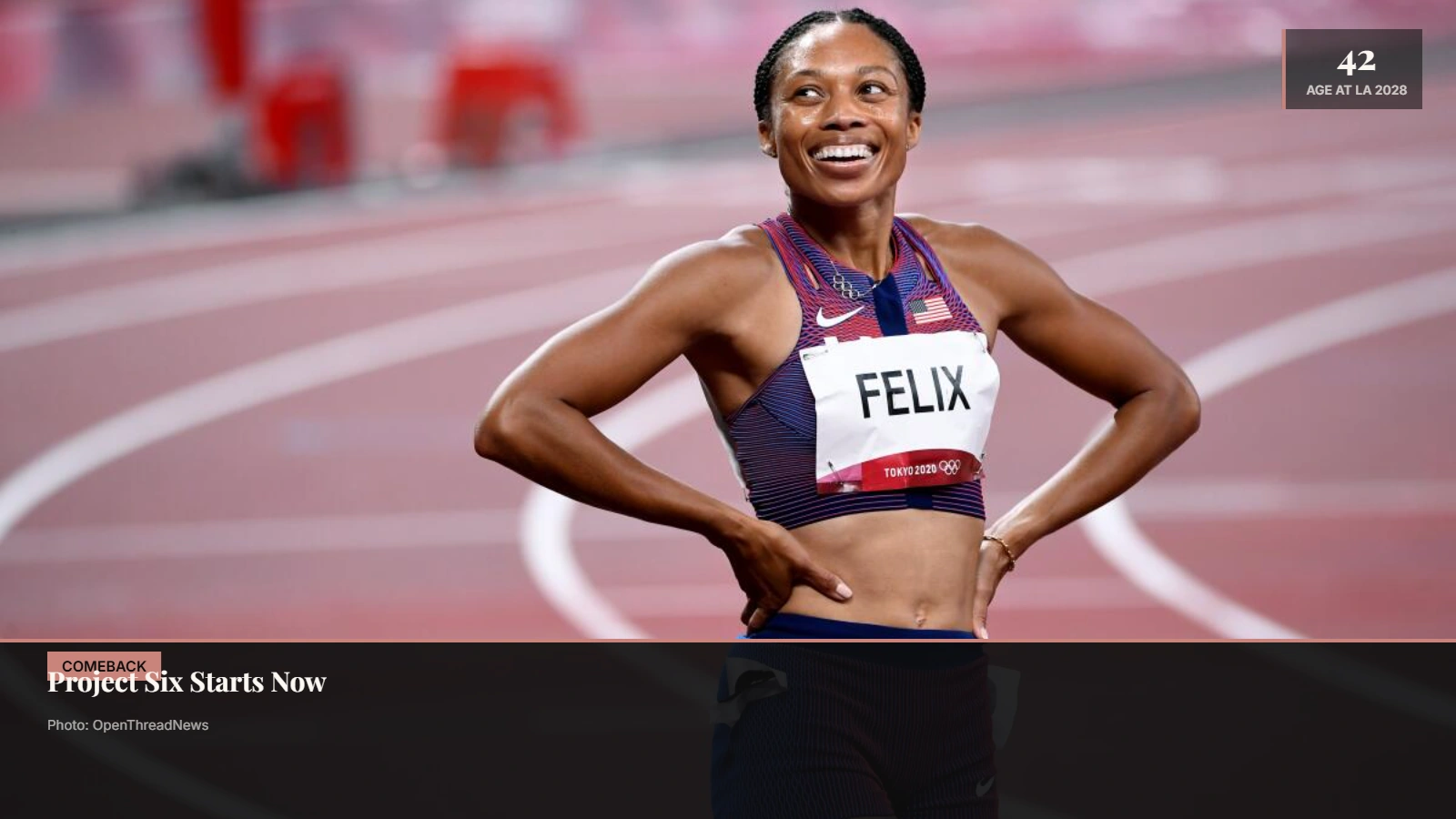
“My ideal situation would be to try to make the relay pool for maybe the mixed 4x400m relay,” she told the TODAY show in May 2026. “It’s a tall task to get back to that level, but I’m excited to really push for it.”
She and longtime coach Bobby Kersee plan to begin a full training schedule in October 2026, with certified competition returning sometime in 2027 ahead of the 2028 Olympic Trials. She will not compete regularly on the global circuit before then, staying close to her children.
Her goal, she told Time, is to walk in the opening ceremony on July 14, 2028, in Los Angeles. “When I was competing, you just heard this roar for host-country athletes at the Olympics,” she said. “I would love to experience that.”
If she qualifies, she would be 42 years old at the Los Angeles Games. The oldest female sprinter to ever compete in the Olympics was Merlene Ottey, who ran the 100m at Athens 2004 at age 44.
Tara Davis-Woodhall and the next generation of Team USA athletes will be competing at full power in 2028. Felix is not entering that conversation to compete with them. She is entering it on a different frequency entirely: to ask, on the biggest stage in sports, in her own hometown, what is still possible when the world says you should be satisfied.
The answer arrives in two years.
Frequently Asked Questions
Is Allyson Felix coming back to compete?
Yes. On April 27, 2026, Felix announced she is ending her retirement and targeting a sixth Olympic Games at the 2028 Los Angeles Olympics. Her plan, which she calls “Project Six,” focuses on making the relay pool for the mixed 4x400m relay. She will begin full training with coach Bobby Kersee in October 2026 and expects to return to certified competition in 2027.
How old is Allyson Felix?
Allyson Felix was born on November 18, 1985, making her 40 years old as of 2026. She will be 42 years old at the 2028 Los Angeles Olympics.
How many Olympic medals does Allyson Felix have?
Felix has 11 Olympic medals: 7 gold, 3 silver, and 1 bronze, earned across five Olympic Games from Athens 2004 to Tokyo 2020. She is the most decorated U.S. track and field athlete in Olympic history and also holds 20 World Championship medals, including 14 gold medals.
Who is Allyson Felix married to?
Allyson Felix is married to Kenneth Ferguson, a former hurdler. They have two children: daughter Camryn Grace, born on November 28, 2018, and son Kenneth Maurice Ferguson III (Trey), born on April 10, 2024.
What is Saysh, Allyson Felix’s shoe brand?
Saysh is a women’s footwear brand Felix co-founded after leaving Nike and launched ahead of the Tokyo 2020 Olympic Games. The brand was built on the idea that most athletic shoes are designed using male foot models. Saysh creates shoes engineered specifically for the female foot. Felix has also donated shoes to college women’s sports programs and uses the brand as part of her broader advocacy for women in sports.
What was Allyson Felix’s dispute with Nike?
During contract renegotiations in 2018, Nike proposed reducing Felix’s pay by 70% if she did not perform at pre-pregnancy levels during the period surrounding childbirth. Felix, who was pregnant at the time, requested written maternity protections, but Nike declined. After experiencing a dangerous pregnancy and emergency C-section, she publicly shared her story in a 2019 New York Times op-ed. The response led to widespread public attention and a congressional inquiry. Nike later introduced a maternity policy guaranteeing 18 months of pay protection around pregnancy. Felix subsequently left the company and founded Saysh.