

Nobody in American track and field carries more weight into a race than Sha’Carri LaNay Richardson. Not because of the pressure placed on her by others, but because of the pressure she has placed on herself since the moment she arrived.
At 26 years old, the Dallas native is a two-time Olympic medalist, a world champion, and arguably the most recognizable sprinter on the planet right now. She has come back from a suspension that cost her the Tokyo Olympics, a public breakup that played out on social media, and two years of being told her window might have closed. And she is currently midway through what she has declared will be a “legendary” 2026 season. At the LA Grand Prix on June 15, 2026, she opened her U.S. season debut with a 10.99-second 100m win, leading an American podium sweep.
The wins matter. So does the story behind them.
(Note: Richardson is not related to McKinley Richardson, the influencer profiled separately on this site. Two different people, two completely different fields.)
South Dallas, Betty Harp, and Where It All Started
Richardson was born on March 25, 2000, in Dallas, Texas. Her biological parents were largely absent from her childhood. Her father has never been publicly identified. Her biological mother left when Richardson was young, and Richardson only learned of her mother’s death in 2021 when a journalist asked about it mid-interview — a moment she has described as one of the hardest of her life.
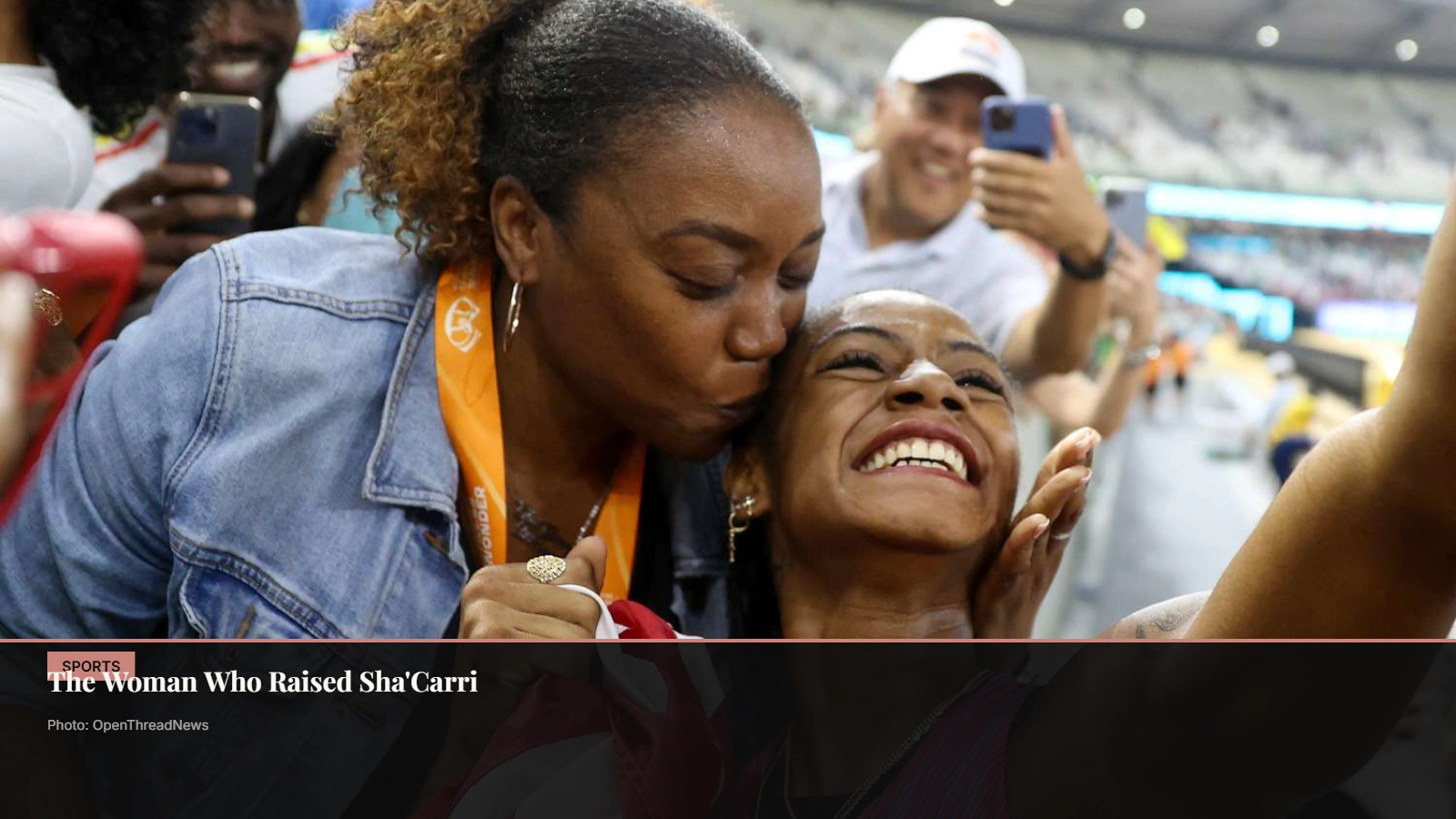
The woman who raised her is her grandmother, Betty Harp, known to Richardson as “Big Momma.” Her aunt, Shayaria Richardson (whom she calls her mother), co-raised her in South Dallas. It is Shayaria’s track medals — found by a nine-year-old Sha’Carri in a shoebox — that first lit the fire.
“My grandmother made her a big plaque full of medals, and I saw it one day and was like, ‘I want that. I want you to bring me one, Granny,'” Richardson told Teen Vogue. Betty Harp’s response: well, you’re going to have to earn some.
Betty Harp’s presence at Richardson’s races has become one of track’s most beloved recurring images. In 2021, Harp boarded a plane for the first time in her life to watch Richardson compete at the U.S. Olympic Trials. After Richardson won the 100m, she ran straight into her grandmother’s arms. That image went everywhere. Richardson has called the moment her “childhood wildest dream come true.”
Harp was also courtside in Paris. NBC’s cameras kept finding her in the stands.
Breaking LSU Records and Arriving on the World Stage
Richardson attended Carter High School in Dallas before enrolling at Louisiana State University in 2018. As a freshman in 2019, she broke the NCAA Division I 100m record with a time of 10.75 seconds at the NCAA Championships — making her one of the ten fastest women in history at just 19 years old.

That same day, she also broke the Under-20 world record in the 200m, setting two global records in a single afternoon. It was her freshman year, and it immediately attracted Nike, which has sponsored her since 2019 and remained loyal through every controversy that followed.
By April 2021, she had improved her 100m personal best to 10.72 seconds, positioning her as the clear favorite for gold at the Tokyo Olympics. She won the U.S. Olympic Trials 100m in Eugene, Oregon, clocking 10.86 seconds. Betty Harp flew for the first time to watch it happen.
Then came the story that changed everything.
Tokyo, the Suspension, and Learning About Her Mother Mid-Season
Days after winning the Olympic Trials, Richardson tested positive for THC (cannabis) following a test conducted in Oregon, where recreational use is legal. The U.S. Anti-Doping Agency issued a one-month suspension, which was enough to disqualify her from the Olympic 100m.
Richardson addressed it publicly and directly: she had used marijuana after learning, mid-competition, that her biological mother had died. A reporter told her during an interview. She processed the news alone, in the middle of an Olympic qualifying season, in a state where cannabis was legal, and still ran one of the fastest times in history.
The backlash was significant. So was the outpouring of support. Nike released a statement praising her “honesty and accountability.” The WADA rules under which she was penalized drew fresh criticism, particularly given the substance’s legal status in the state where she used it. Track fans, athletes, and celebrities rallied around her.
She was still barred from Tokyo.
“I almost have to remind myself, ‘Hey, you are that girl. You have done this before!'” she told Nike in a later interview. “I’m not back, I’m better.”
The Comeback: 2023 Worlds and the Paris Redemption
The two years after Tokyo were a process of rebuilding, both publicly and privately. Richardson dealt with a difficult breakup, health challenges, and the kind of intense public scrutiny that comes with being the most searched sprinter in America. Her results on the track were inconsistent. The narrative shifted toward whether she would ever fully deliver on the promise of that 2019 record.
Budapest answered that.
At the 2023 World Athletics Championships in Hungary, Richardson won the 100m gold medal in 10.65 seconds, a championship record. She then claimed bronze in the 200m and gold in the 4x100m relay, finishing the championships with three medals. It was the defining performance of her career to that point, a direct line from South Dallas to the top step of the world stage.
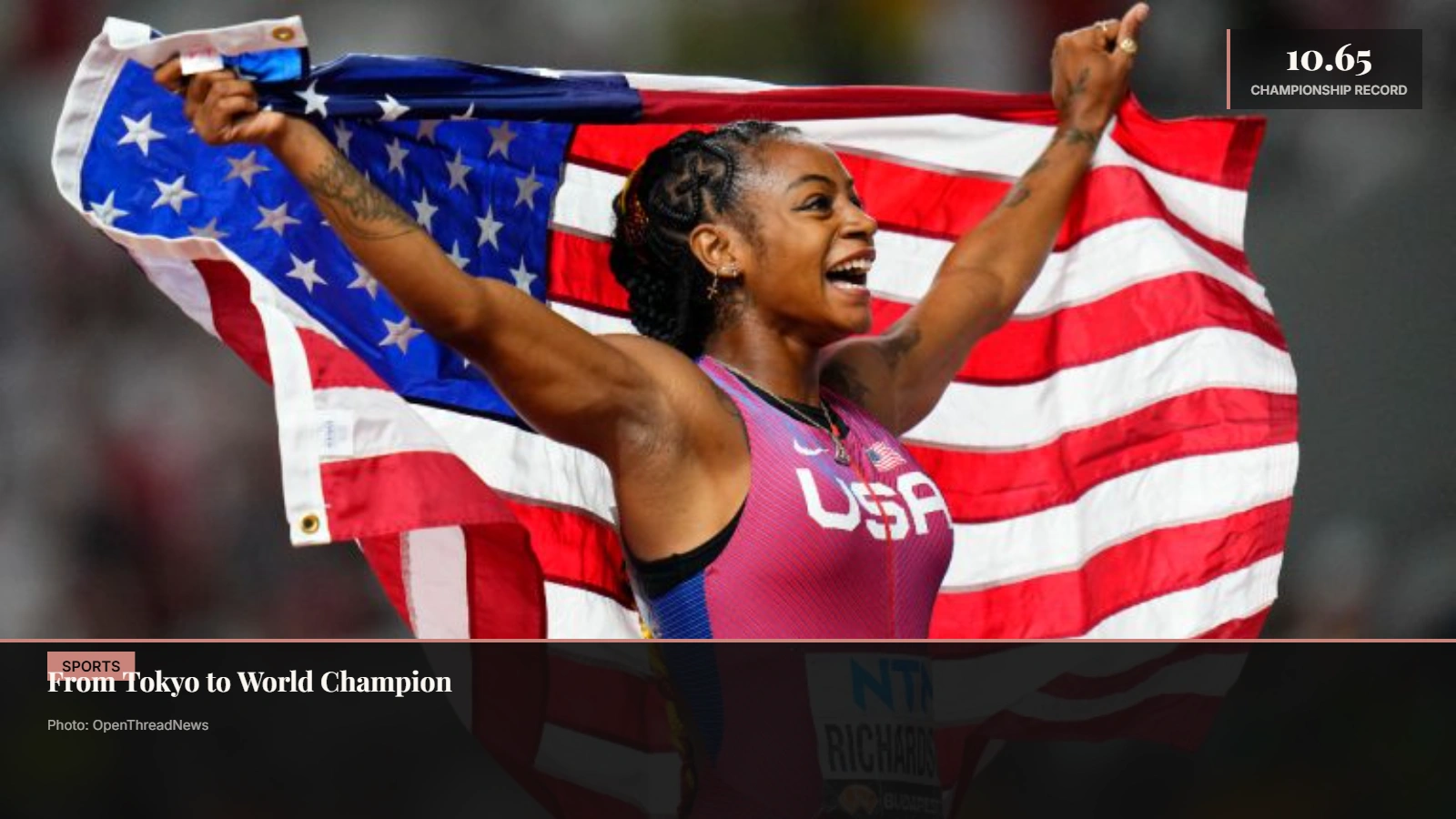
Paris 2024 added to it. Richardson took silver in the 100m (losing to Julien Alfred of St. Lucia) and gold in the 4x100m relay, running the anchor leg alongside Gabby Thomas, Tara Davis-Woodhall, and teammates in a race that secured the top of the podium for Team USA. She left Paris with two Olympic medals and a reputation that had fully shed the Tokyo shadow.
What She Actually Does on the Track
Richardson specializes in the 100m and 200m, with most of her major titles coming in the shorter event. Her personal best of 10.65 seconds (set at the 2023 World Championships) places her among the five fastest women in history in the event. She has also broken the 10.62-second mark in unofficial conditions.
She is an explosive starter who tends to dominate the first 60 meters and hold speed through the finish. Her coach through her professional career has helped her develop consistency, but Richardson has always been more of a natural talent story than a technical one. The body does things most coaches can only describe in theory.
In relay events, she typically runs the anchor leg for Team USA, which is the highest-pressure position and the one assigned to the fastest runner. In May 2026, she anchored a 4x100m relay team alongside training partners to a 41.70 world lead, faster than the gold-medal time from Paris 2024.
Sydney McLaughlin-Levrone and Gabby Thomas are her closest Team USA counterparts in terms of public profile, though their events rarely overlap directly.
The Look, the Nails, and Why It’s All Intentional
Track and field has historically been one of the most conservative-looking Olympic sports. Richardson arrived and treated it like a runway.
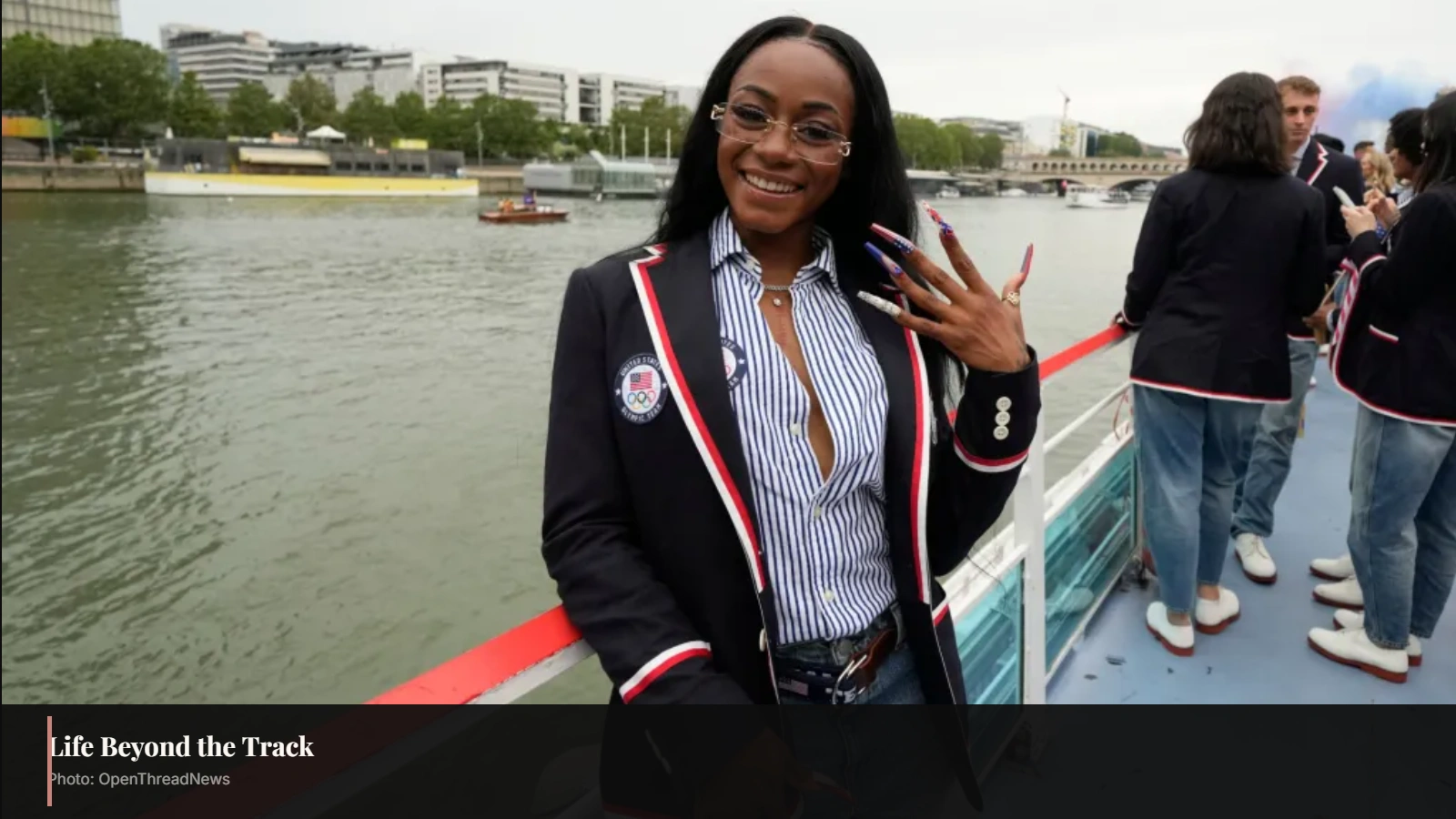
Her long acrylic nails sparked immediate conversation when she first appeared at major meets. She has explained that the style was inspired by her grandmother, and that she only later noticed the resemblance to Florence Griffith Joyner, whose own long nails became iconic during the 1988 Seoul Olympics. That connection was accidental. The commitment to it was not.
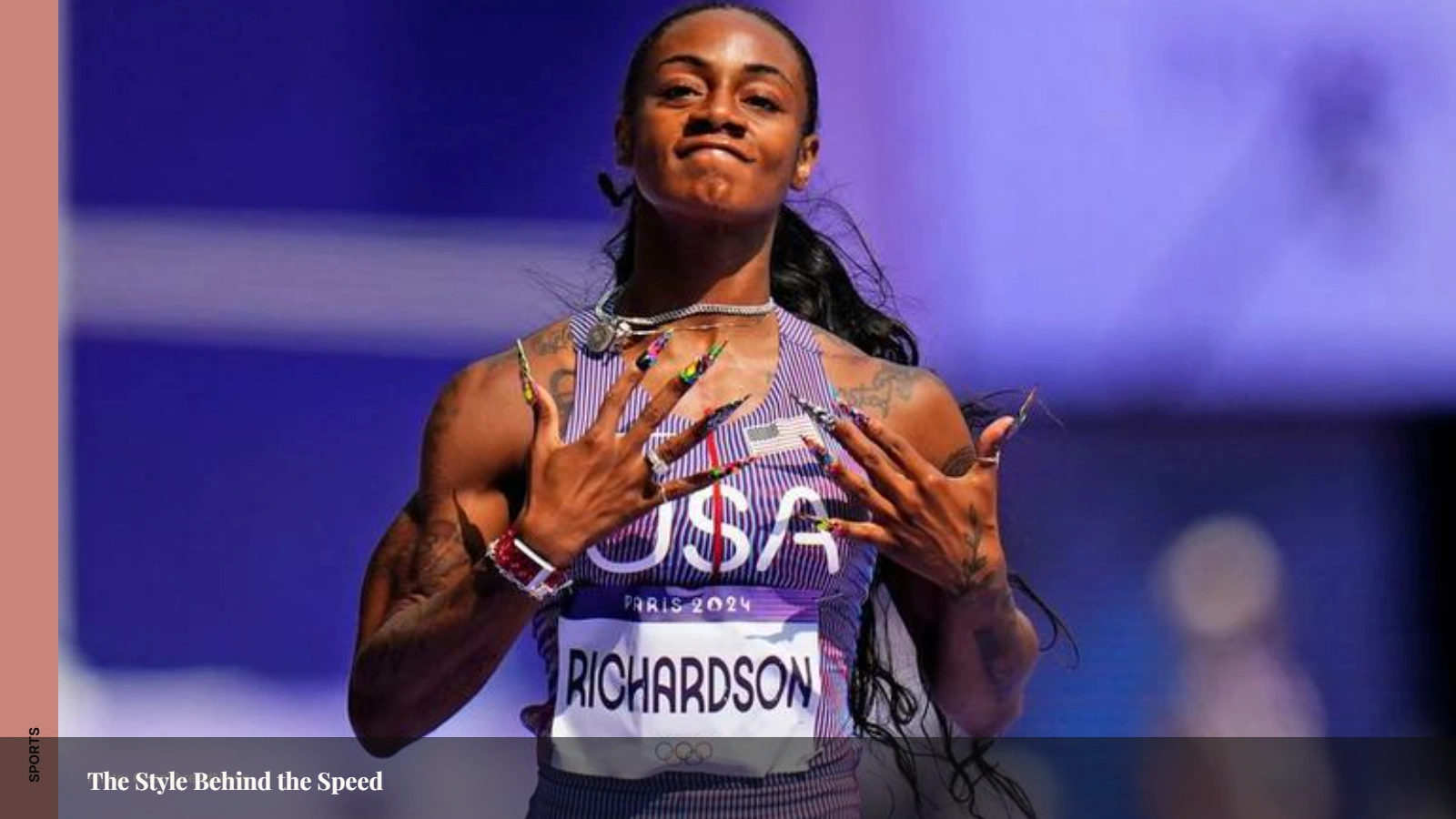
Her hair changes by season, often by meet. Orange. Red. Pink. Platinum. Each color tends to generate its own news cycle. Her then-girlfriend Janeek Brown famously picked the orange shade she wore at the 2021 Olympic Trials, the one that made her face recognizable to millions of people who had never watched track before.
The fashion presence has attracted serious brand interest. She is the face of Nike, which stood by her through the Tokyo controversy and has since made her a centerpiece of campaigns including the Nike x Jacquemus Spring 2024 collection (a collaboration with French designer Simon Porte Jacquemus that produced the first Nike handbag). She also has partnerships with Beats by Dre and Apple Music.
A rumored $20 million, five-year Nike contract has never been officially confirmed, but the scope of her activation in their campaigns suggests a relationship built for the long term.
She attended the 2025 Met Gala and has been photographed at New York Fashion Week. She is also an adviser-owner in ATHLOS, the women-only track meet founded by Alexis Ohanian, alongside Gabby Thomas and Tara Davis-Woodhall.
Personal Life: Private, Complex, and on Her Terms
Richardson came out as bisexual in 2015 in a tweet, writing “My family know im bi.” She has been matter-of-fact about her identity since then, while keeping the specifics of her romantic life largely private.
From 2019 to early 2022, she was in a relationship with Janeek Brown, a Jamaican hurdler. The breakup became public and painful. Richardson posted on Instagram that she had been abused and stolen from during the relationship, and that she had protected her partner from the judgment of her home country while enduring homophobia. Brown later confirmed one instance of physical abuse in a public statement. Richardson has since said she wants peace, not drama, and has moved on.
As of 2025 and 2026, she has kept her relationship status private. A Vogue profile described her personal life as “off-limits.” Rumors have linked her to fellow U.S. sprinter Christian Coleman, but nothing has been confirmed. She has hinted at a mystery partner through social media posts, and then left the thread hanging.
That restraint reads as intentional. Richardson controls what gets out about her, and she has been burned by public exposure before. The nails and the hair are all the vulnerability she needs to offer.
Sha’Carri Richardson’s Net Worth
Estimates place Richardson’s net worth at approximately $4 to $5 million, reflecting her Nike contract, Beats by Dre and Apple Music deals, Diamond League prize money, ATHLOS ownership stake, and media appearances.
The Nike deal is the anchor. She has been with the brand since 2019, and it survived the Tokyo controversy intact. The Jacquemus collaboration in 2024 elevated her positioning from athlete to genuine fashion figure, which opens categories of sponsorship money that most track athletes never access.
Her 2023 World Championship victory triggered a meaningful bump in her commercial value. A world champion at 23, with a story built for mass appeal, became significantly more attractive to brands than a promising sprinter with an asterisk. The trajectory since Budapest has been upward.
She does not have a merchandise business or an independent media property in the way some creators do, but her social following and cultural visibility mean those options exist whenever she chooses to pursue them.
Sha’Carri Richardson in 2026: Targeting Legendary
Richardson has called 2026 a season she intends to make legendary. The results so far support the ambition.
She opened her outdoor season racing in Australia, then moved to Florida for relay training, helping Team USA to a 41.70 world lead in the 4x100m relay in May. At the Shanghai Diamond League (May 16), she finished fourth in the 200m in 22.42 seconds behind Shericka Jackson, showing room to grow in the half-lap event she has been incorporating more this year. At the LA Grand Prix on June 15, 2026, she returned to home soil and won the 100m in 10.99 seconds, leading an American podium sweep. She noted she was “just prepared to keep training and finish stronger than before.”
The 2026 season is a non-Olympic year, which takes some of the title-chasing pressure off and gives athletes space to build. Richardson is using it to extend her range and sharpen the edges. The World Ultimate Athletics Championships are on the calendar for September 2026.
The 2028 Los Angeles Olympics sit two years away. The LA Grand Prix where she just won was held at Allyson Felix Field at UCLA’s Drake Stadium — a detail that carries weight whether she registered it or not. Allyson Felix, who holds U20 records Richardson has now broken, trained and competed in that same city. The baton passes in track are rarely literal, but this one feels like it.
Richardson has never been the kind of athlete who softens ambition with humility. She said she wants to be legendary. She probably means it.
Frequently Asked Questions
How old is Sha’Carri Richardson?
Sha’Carri Richardson was born on March 25, 2000, making her 26 years old as of 2026. She was born and raised in Dallas, Texas.
Who raised Sha’Carri Richardson?
Richardson was raised by her grandmother, Betty Harp (known as “Big Momma”), and her aunt, Shayaria Richardson, in South Dallas. Her biological parents were largely absent from her childhood. She learned of her biological mother’s death in 2021 when a reporter asked about it during an interview.
Why did Sha’Carri Richardson miss the Tokyo Olympics?
Richardson tested positive for THC (cannabis) following the 2021 U.S. Olympic Trials. She received a one-month suspension from USADA, which disqualified her from the Olympic 100m. She later explained she had used cannabis in Oregon, where it is legal, after learning mid-season that her biological mother had died.
What is Sha’Carri Richardson’s net worth?
Sha’Carri Richardson’s net worth is estimated at $4 million to $5 million. Her primary income source is her Nike endorsement deal, which has been in place since 2019. She also earns from partnerships with Beats by Dre and Apple Music, prize money from Diamond League events and world championships, and an ownership stake in ATHLOS.
Is Sha’Carri Richardson married?
No, Sha’Carri Richardson is not married and has not publicly confirmed a current relationship. She has been open about identifying as bisexual since 2015. Her last publicly known relationship was with Jamaican hurdler Janeek Brown, which ended in early 2022. She has described her current personal life as private and off-limits in interviews.
What is Sha’Carri Richardson’s 100m personal best?
Richardson’s official personal best in the 100m is 10.65 seconds, set when she won gold at the 2023 World Athletics Championships in Budapest. She has also recorded a time of 10.62 seconds under conditions that were not ratified for record purposes.